
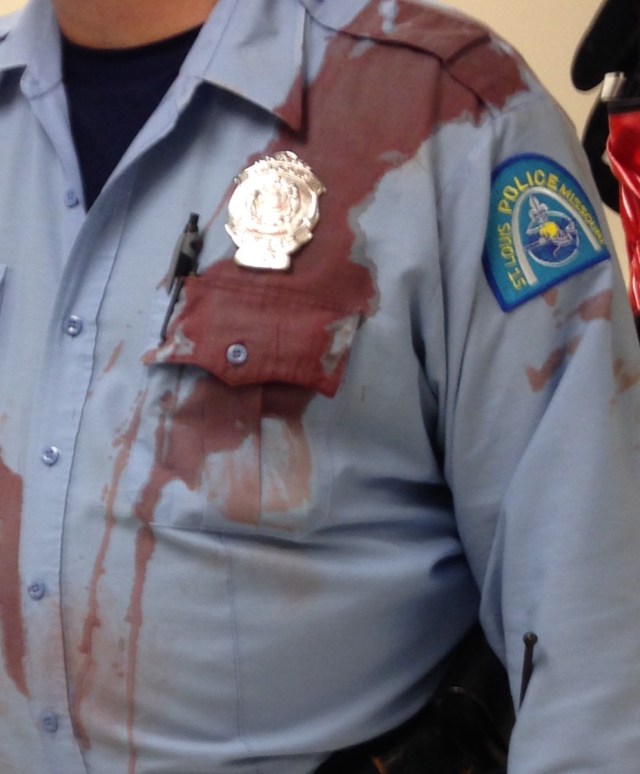
‘It’s still a blast beating people’: St. Louis police indicted in assault of undercover officer posing as protester
The headline above is from the Washington Post news site. That paper serves a community 900 miles away from St. Louis, MO, where the incident described took place.
The headline is so wrong, yet so right at the same time.
It’s wrong because St. Louis police weren’t indicted for an assault, but rather, four of around 1000 of our officers were indicted for an assault of an undercover officer, one of our own.
It’s so correct though because, in reality, St. Louis police did get indicted, beyond just the four of around 1000 officers we have, in the court of public opinion.
Perhaps not just St. Louis police either, but police officers everywhere.
It doesn’t matter to the next person I pull over or stop to talk to that I wasn’t one of the four officers being charged with a crime in federal court. That I, or even an officer in some small town 1000 miles away, wear the same uniform makes us one of those four officers to most people in the community.
We are the police, and when one of us legitimately screws up, we all screw up.
We all lose.
Police officers lose.
The criminal justice system as a whole loses.
Society loses.
Is it fair?
Is it fair to cast a negative light on “the police” when one or a few screw up?
I want to say no, but I can’t, honestly.
If I were a regular citizen who didn’t have much contact with the police, I would be apprehensive of any police officer who stopped me too.
I’d walk on the other side of the street to avoid police contact altogether, were it an option.
It’s too risky to hope the cop you happen upon or who responds to your call is one of the “good ones.”
I always laugh when I read a police report that says a person was “acting nervous,” as though that’s something we should hold against them. I’ve been a cop for twenty years and I get nervous when a police car is behind me when I’m driving. That’s a true story.
Police activity, and especially police misconduct is a popular topic.
True crime books and podcasts are some of the most popular.
Search any major newspaper today and you’ll find this indictment story. From Tacoma to Kansas City to Washington, DC, it’s there.
It’s there, and it’s embarrassing. It’s the second most read story on the Washington Post web page.
I would love to be able to say that these were just four terrible people who became cops somehow and are accused of doing something totally in line with their terrible characters, but that’s not the case, and it’s a huge part of what makes this so frustrating for me personally.
They aren’t terrible people, or they aren’t people I know to be so.
They’re people I like.
I taught three of them in the police academy when they were recruits in training.
I was hyper-aware of bad apple potential when I taught in the police academy, and none of the three I taught were people I’d have pegged to be bad apples.
The undercover detective who was assaulted is a man I really like as well. I’ve known him all twenty of my years as a police officer and have never known him to be anything but a good, good guy. I believe whatever version of the story he says happened. He’s earned that credibility with me.
Why did this happen then? How?
I don’t know.
I want to talk about the bigger picture rather than this incident in a vacuum though. I don’t know enough of the facts, so it would be unfair for me to speculate on this indictment.
As to the text messages, which you can read in any of the news articles discussing this matter, I would say this – take those with a grain of salt, or at least consider the context in which they were said.
It’s casual conversation meant to stay between young men venting their frustration and anger during a period when they were under a lot of duress.
Is it dumb to put it in writing?
Big time yes.
Did Officer Don tell every one of his law recruits that they should assume that anything they type or text should be assumed readable to the world via open records requests and to be careful?
Yes.
Having said that, I can’t put into words how terrible Civil Disobedience Team response is.
It has to be done, but it’s frustrating. You really do almost have to lie to yourself to motivate yourself to do the job.
Even though many of us may agree with much of what many of the protesters are saying, they don’t believe that, and property still has to be protected, even if we’re all in agreement anyway.
If you’ve never looked into the eyes of people who disdain and hate you for no good reason other than your job, and who are willing and able to voice their opinions right to your face, then you just don’t get it.
You can’t, through no fault of your own. You have to experience it.
I’m not making excuses, and if these officers did terrible, unlawful things, they should be punished somehow, but the protests that led to this was an ugly situation that people above their pay grade let get out of hand.
I want my police officer readers to think about this though. Those who know these guys, or other police officers who’ve been in trouble with the law, and who you will or do still call friends and say things like, “they’re not bad guys,” ask yourself if you honestly give people you arrest for similar things the same benefit of the doubt, in spite of their arrests.
If your answer is yes, you’re probably lying. If it’s no, ask yourself why not?
“Each of us is more than the worst thing we’ve ever done.”
I highlighted this text in a book I read called Just Mercy by Bryan Stevenson. If you’ve never read it, I highly recommend it.
Bryan Stevenson is a prominent civil rights attorney who helps people who’ve been wrongfully convicted of crimes they didn’t commit.
His description of the arrest and conviction of Walter McMillian is both unbelievable and frightening. There are other stories and even some of his own personal police encounters that are worth reading.
As a police officer, it’s hard to read these stories. It’s hard to admit that mistakes have been made.
It’s hard to own up to the fact that my chosen profession isn’t always perfect.
I’ve also started listening to podcasts. One of my favorites is called Criminal, by Phoebe Judge.
One episode that really struck me was the wrongful arrest of Willie Grimes for a rape he didn’t commit in North Carolina. You can listen to it here.
Willie Grimes spent 24 years, 9 months, and 23 days in prison.
Can you even imagine that?
His case isn’t really the fault of the cops, because a woman identified him as the guy who did it. Still, the “system” should have done a better job of allowing him to spend so much time in jail, whether that be to not allow the eyewitness testimony of one person be the determining factor in guilt, or by not letting rape kits or dna evidence sit in locker rooms untested.
If guilt or innocence can be ascertained with more certainty, especially in the most egregious cases, even after the fact, don’t we have a duty to figure that out? To at least try?
Mr. Grimes lost family members and friends to death during his incarceration, and left prison a sixty-seven year old man in a strange new world.
How terrible is it to send innocent men to prison?
It should disgust us to our cores, quite frankly. It’s third world country stuff, in my opinion.
We should be doing everything we can to make sure that it doesn’t happen, but we’ve become so accustomed to putting people behind bars in the United States, even for the slightest of crimes, that we don’t even give it a second thought.
What does this have to do with anything?
This is just policing in the United States.
We arrest and arrest and arrest, until being in jail is just normal or expected for people.
It’s become too disjointed.
You give us a gun and a badge and metal handcuffs and you throw us in the streets while asking us to solve some of society’s most difficult problems.
A crime occurred? Call the police.
There’s a dangerous animal running loose? Call the police.
There’s an elementary school student acting up and the teachers can’t control him? Call the police.
Somebody is having a medical emergency? Call the police.
There’s a naked person running around having a mental health episode? Call the police.
If an alien landed on our planet and we described to him what we expect from our police officers, and that we give the police the power to put other human beings in cages, sometimes for even the smallest of city ordinance violations, the alien would surely think that police officers are some of the highest paid or well educated citizens in the community.
We’d all have a good laugh at that for sure, but why don’t we give it more consideration?
Why are police officer standards so low compared to the expectations and powers we are granted?
Because the truth is that sometimes, you need a ruffian to be able to catch a ruffian.
Higher standards would exclude too many ruffians.
The job isn’t for a lot of people, but we’re not even able to attract fringe candidates with more education and training with an offer of a great salary or benefits, so society is getting what it pays for.
Literally.
You call the police for everything and then you act outraged and shocked when a very tiny percentage of those contacts turn tragic.
It’s a terribly small percentage, but police misconduct is “out of control” in many conversational circles.
I’m just flustered at this point in my life, I guess.
I see goodness and talent all around me in my own department, but then something like this happens and it’s like we’re back to square one again.
I feel like I’ve wasted twenty years of my life.
I know that this department, mine, is one of the best in the area, maybe even the country.
It has a long and distinguished history, one that far surpasses that of most others.
That’s why when bad things happen here, I know that they can and do happen elsewhere, with more frequency, and it sucks.
It sucks that when it happens elsewhere, I will be judged again.
Other officers with nothing to do with it will be judged, and nothing will be done to make things better, or at least to make things different, to see how different works.




 don of all trades